Tools
Tools versions
Section titled “Tools versions”The extension will show the currently installed tool versions directly in the editor

Hovering a tool in a config file shows its backend, its description, its
versions and the options set on it (lazy, os, postinstall, …), and:
- a link to the website of the project, when the registry has one
- the latest version, when the installed one is outdated, with a link to its release notes when the backend publishes them (e.g. GitHub releases, mise 2026.8.15+)
Tool explorer (activity bar)
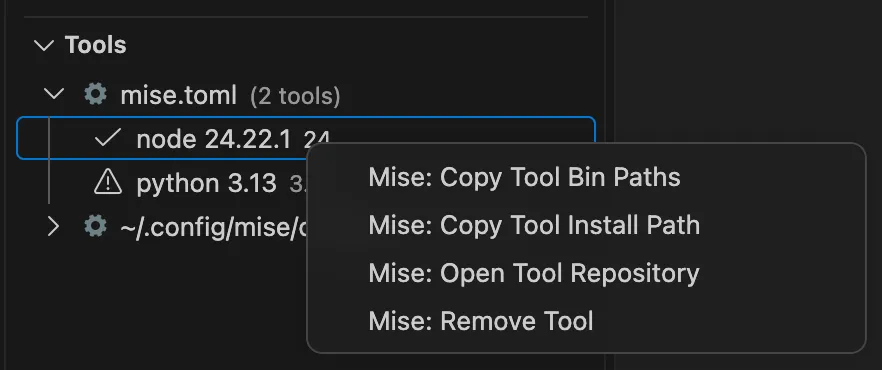
Section titled “Tool explorer (activity bar)”The tool explorer in the activity bar allows you to quickly which tools are used in the current project. You can also the list of global tools.
- Click on a tool to navigate to the file where it is defined
- Some additional options are available on right-click, like copying the bin/install path or removing the tool
The + button of the explorer adds a tool to a config file with mise use.
Pick a tool from the registry, by its name or its description (json finds
jq), or type one as backend:name (e.g. github:cli/cli), with its version
if you want (npm:prettier@3). After npm:, cargo:, gem: or dotnet:, the
registry tools with that backend come first, then the npm, crates.io, RubyGems
or NuGet packages that match (mise 2026.9.13+).
A config file that does not parse is marked in the explorer. Its tools are the ones from the last time the file parsed. See While a config file is being edited.
Lazy tools
Section titled “Lazy tools”Tools declared with lazy = true are installed by mise the first time one of
their commands runs. Until then, they are not reported as missing: the explorer
and the editor show them as installs on first use instead of not installed.
The extensions configured with the path of a tool (see
supported extensions) only pick
it up once it is installed.
[tools]ripgrep = { version = "14", lazy = true }Lockfile
Section titled “Lockfile”mise.lock records the
versions that the tools of mise.toml resolved to. Code lenses on top of
mise.lock (and mise.local.lock) show:
- whether it has every tool of the config:
In sync, or2 tools out of sync · Update, which runsmise lock. The tooltip lists the changes.mise lockalso updatesmise.local.lock, for the tools ofmise.local.toml. Bump 3 toolswhen the requests allow newer versions (e.g.node = "24"): runsmise lock --bump, which updates the lockfile without installing anything. Finding them looks up the versions online.Upgrade format v0 → v3for a lockfile written in an older format: runsmise lock --upgrade. Everyone who reads the lockfile, CI included, then needs mise 2026.9.16 or newer.
Next to [tools] in a config file (mise.toml, mise.local.toml, …):
mise.lock out of datewhen its lockfile does not match the config, e.g. after adding a tool by hand.Create mise.lockwhen there is no lockfile yet andlockfile = true. With the setting unset, mise does not create lockfiles automatically, and the extension does not suggest it either.
Each lens asks for confirmation first, and shows the command it runs.
Nothing is shown with lockfile = false. Requires mise 2026.9.16+. The
lockfiles of an environment (mise.test.lock), of a monorepo subproject and
the global one are not covered.
Tools list
Section titled “Tools list”Use the list List all tools button to list all installed tools.
- You can filter the tools used in the current project using
activeonly. - From there, you can upgrade, uninstall or prune unused tools
- When a newer version is available, it links to its release notes, for the backends that publish them (mise 2026.8.15+)
